
A living political world
Grand strategy, lived in first person
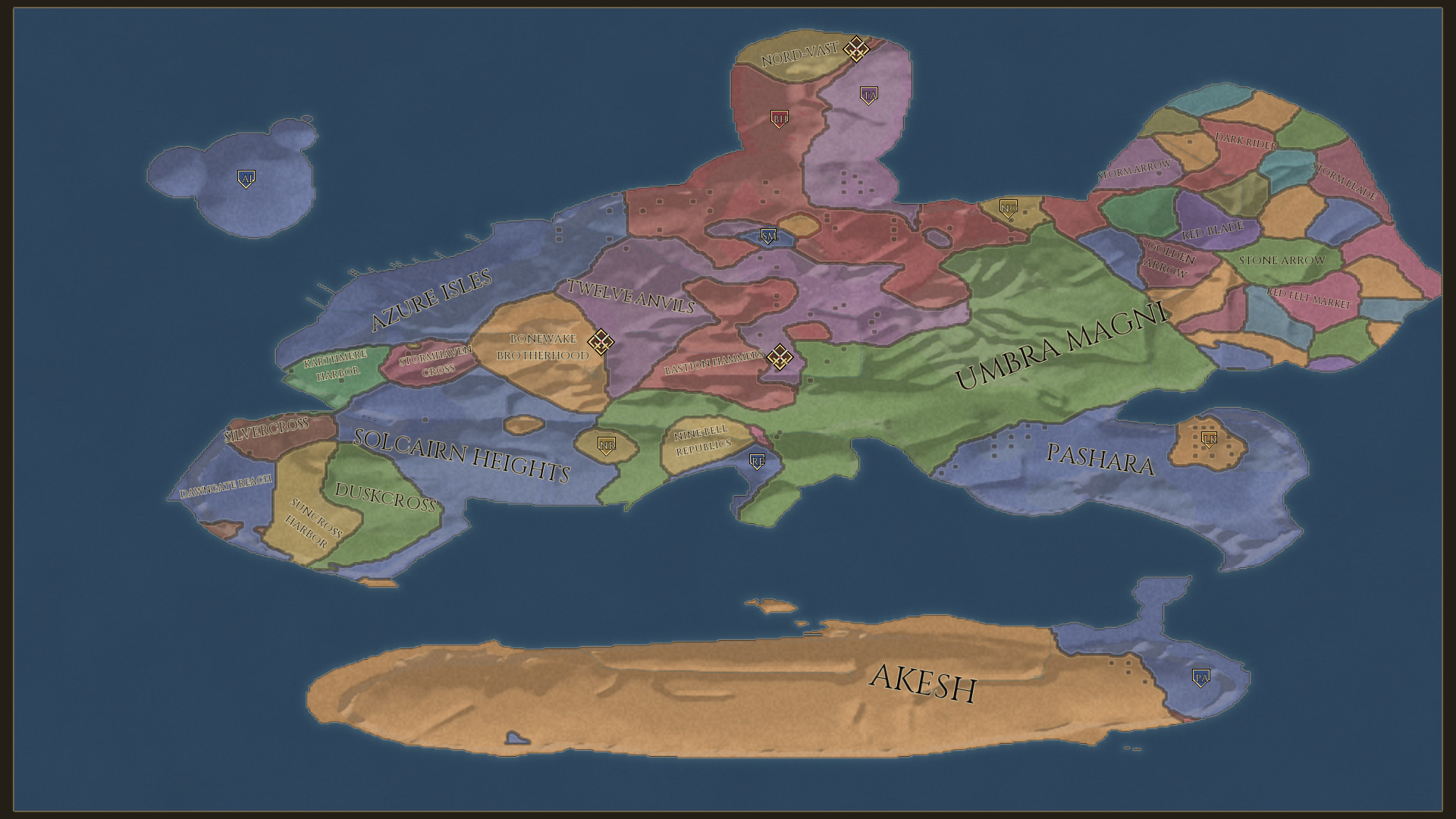
Every colored border belongs to a realm with people, resources, obligations, and ambitions. Those realms wage wars, negotiate treaties, raise armies, and settle successions while you pursue your own life. When you rule, the same simulation becomes your responsibility, from the food in a settlement's stores to the future of your dynasty.
In development · An illustrated walkthrough of the game's strategic systems
In-game capture · In development
A continent of competing powers
Pull back to see the political world at continental scale. Each border belongs to a campaign that keeps unfolding.
In-game Political lens · Development capture
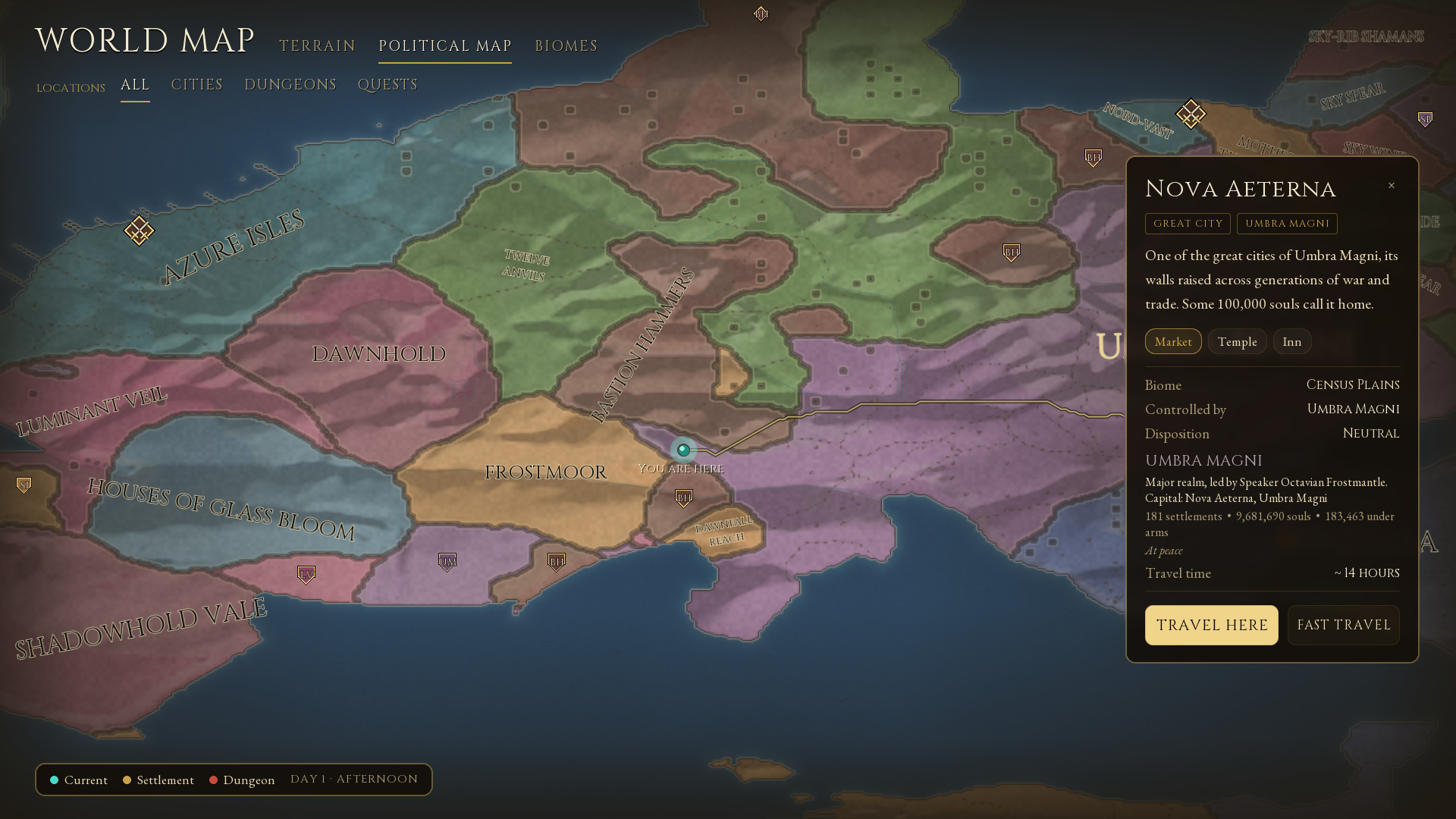
The political atlas
A view of territorial power, roads, and settlements, with Nova Aeterna selected. Names and figures belong to this example campaign.
Read one world at different scales
The map is a view into your world.
The screenshots above and below show the in-game Political lens. During a live reign, additional views help you read your position.
- Terrain · Political · Biomes
- Read geography, territorial powers, and the environments between settlements.
- My Realm
- Your holdings, liege, and enemies during a live reign.
- Wars
- Coalitions, objectives, scores, and battles in active conflicts.
- Claims
- Claims you can press, alongside those that have lapsed.
Read the balance of power
Begin with the world map. The Terrain lens shows the country you must cross; Political reveals territorial powers, settlements, and routes; Biomes helps you read the environments along the way. Select a place to see its information. During a live reign, My Realm adds your holdings, liege, and enemies. Wars exposes attacking and defending coalitions, objectives, scores, and battles. Claims shows the claims you can press and those that have lapsed. Geography and politics become questions of access, danger, and opportunity: who controls the road, who can support a rival, and where can your army sustain a campaign? The screenshots show example campaign states, whose names, borders, and figures can change.
A living world →Choose the obligations of a throne
A ruler start ties your claim to a real settlement and brings you to your physical seat. An independent sovereign controls their own foreign policy; a sworn vassal belongs to a hierarchy with a liege above them. Vassalage can offer protection, but it also brings crown taxes, levy calls, and demands. Refusing an obligation has consequences, and a demand for independence can lead to war. The player progression work also connects service, earned holdings, companies, higher titles, dark necromantic ascension, and mind-thrall hosts to rulership. Necromancer lords face strict diplomatic isolation: living realms refuse their fealty and alliances, leaving only vampire courts and fellow necromancer orders as valid lieges or allies.
From wanderer to ruler →Govern the places people live in
Your holdings have prosperity, loyalty, security, food stores, militia, and paid garrisons. Appoint a governor, set fiscal policy, and decide where scarce resources should go. Higher taxes can pay for defenses while putting loyalty under pressure. Drilling or conscripting people draws labor away from civilian work. A granary, market, barracks, temple, road, or wall requires resources and time, and projects can depend on existing improvements. Undead settlements raised after slaughtering a town operate under stark constraints: shrouded in perpetual darkness and corruption haze, they have zero natural population growth and severely curtailed commerce (a fraction of normal labor yield and no trade or port bonuses).
Cities, districts, and influence →Build a court you can trust
Offices are held by simulated people with competence, loyalty, corruption, traits, relationships, and personal interests. A chancellor can work on relations with a neighbor; a treasurer can pursue arrears; a spymaster can counter intrigue; a warmaster can improve readiness. Action offers expose costs, prerequisites, and the relevant odds rather than guaranteeing success. Schemes work through claims, secrets, influence, and the people involved. A useful appointment may give authority to someone whose ambitions will later trouble you. A failed intrigue may leave scandal, retaliation, unrest, or war in its wake. The person you meet in a hall and the office you depend on belong to the same world.
People, memory, and simulated lives →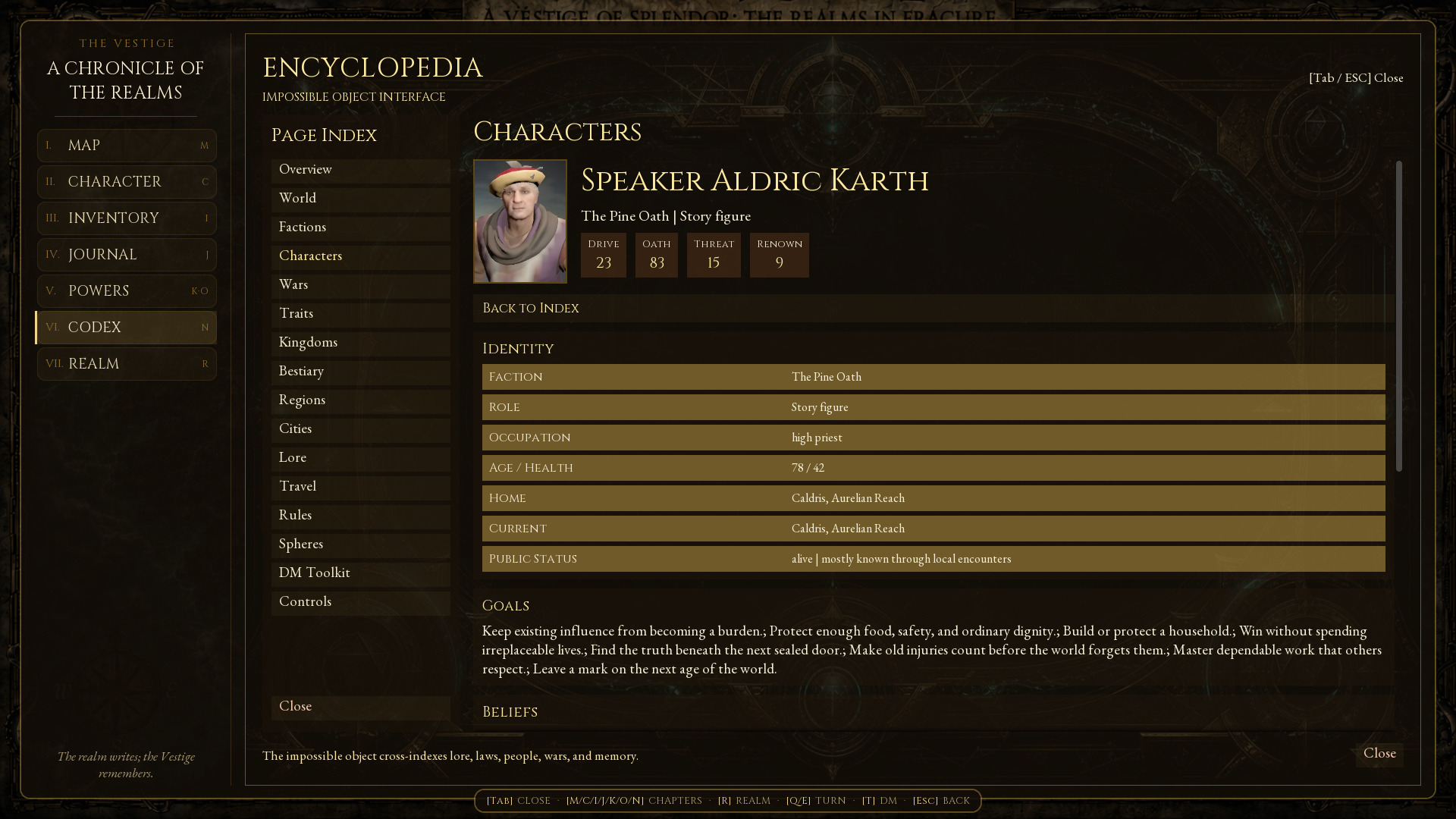
In-game capture · In development
The person behind the name
The in-game encyclopedia records identity, affiliations, goals, and beliefs. Here, Speaker Aldric Karth belongs to The Pine Oath.
Turn grievances into strategy
Alliances, truces, tribute, betrothals, and denunciations shape relationships and obligations between powers. A war has a cause: a claim, reconquest, a broken treaty, Cleanse Cult, or Purge Necromancy—an immediate aggressive war declared by a settlement's former living sovereign when a necromancer slaughters and raises their town. Fabricating a claim targets a particular holding rather than granting a general right to conquer anything. Before pressing it, consider the target's allies, defenses, and champions as well as its apparent weakness. Diplomacy can create room for a campaign, avoid an expensive conflict, or give your dynasty a stake in another court.
Factions and belonging →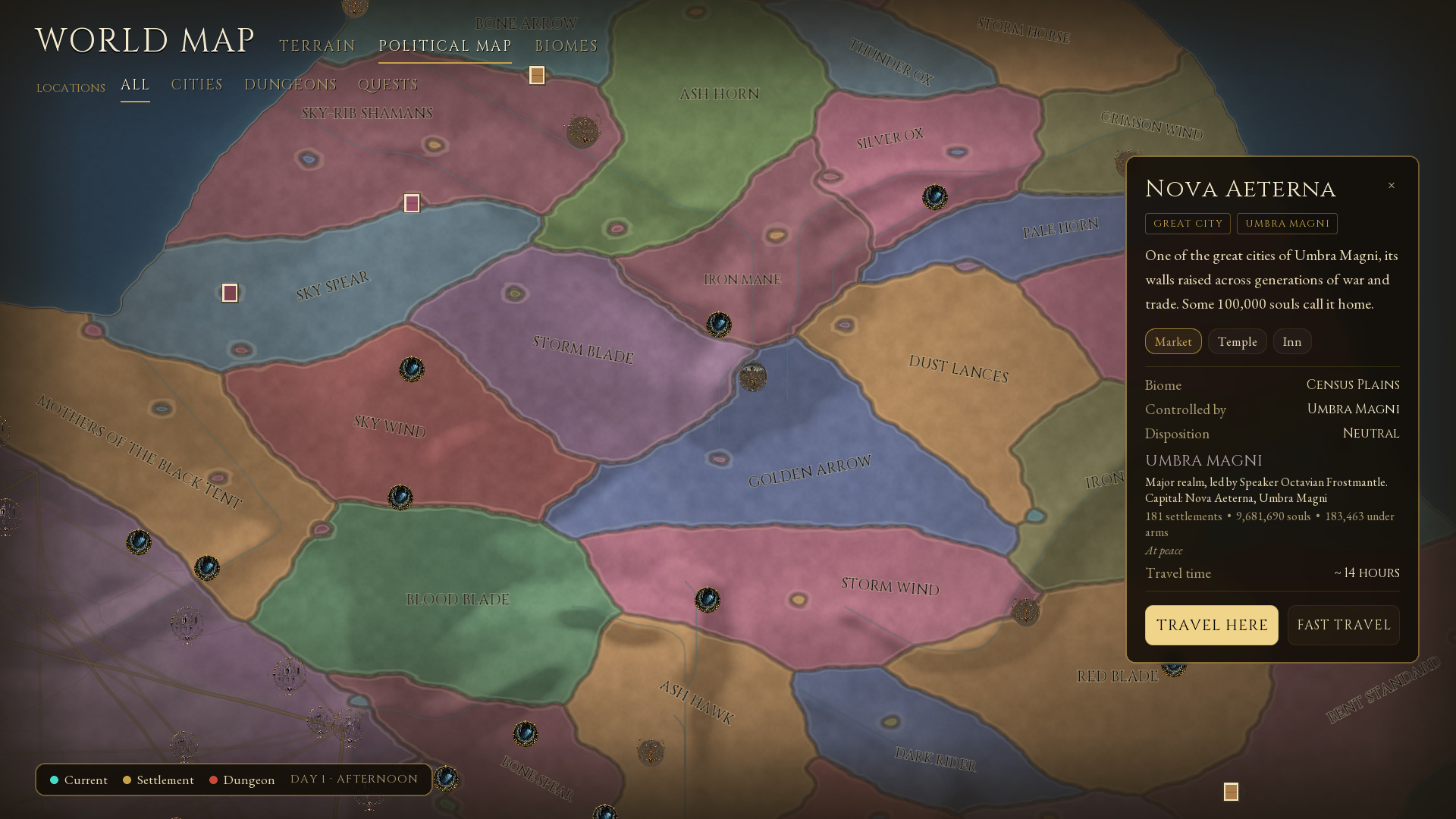
In-game Political lens · Development capture
Powers of the Obsidian Steppe
A closer view of the competing powers of the Steppe. This is one campaign's distribution of territory and influence.
Command a campaign and sustain it
Muster your forces, take the field, and select one of your own army banners on the political map to direct its host. Standing orders can watch a named realm's border or recall a force to its seat. Wars track objectives, battles, siege progress, occupation, and war score. Keeping a living campaign alive requires money, provisions, and people, whereas a necromancer lord cannot hire living recruits at all—building their undead company by raising NPCs killed in dungeons or towns (forming a unit once five or more are raised), raising the dead after field battles, or slaughtering settlements. Mentalists at Level 10+ with Mind Control can instead assemble a thrall army by dominating lower-level NPCs in dialogue once five or more fail their Will saves.
Combat and encounter levels →Leave a realm that can survive you
A reign sits within a history of families, titles, claimants, and cultural law. Succession may turn on birth order, seniority, elections, or partition under particular traditions. Councillors and vassal rulers can matter to an election; legitimacy, claims, and family history shape who has a case for power. An heir's position is a political concern before the ruler dies. The succession system belongs to the wider simulation, so other realms also face these transitions while you live your own life. The player inheritance route and the full range of multi-title outcomes remain in development. Think beyond the next victory: a treasury, a trusted court, and a credible succession can all become part of what your reign leaves behind.
From wanderer to ruler →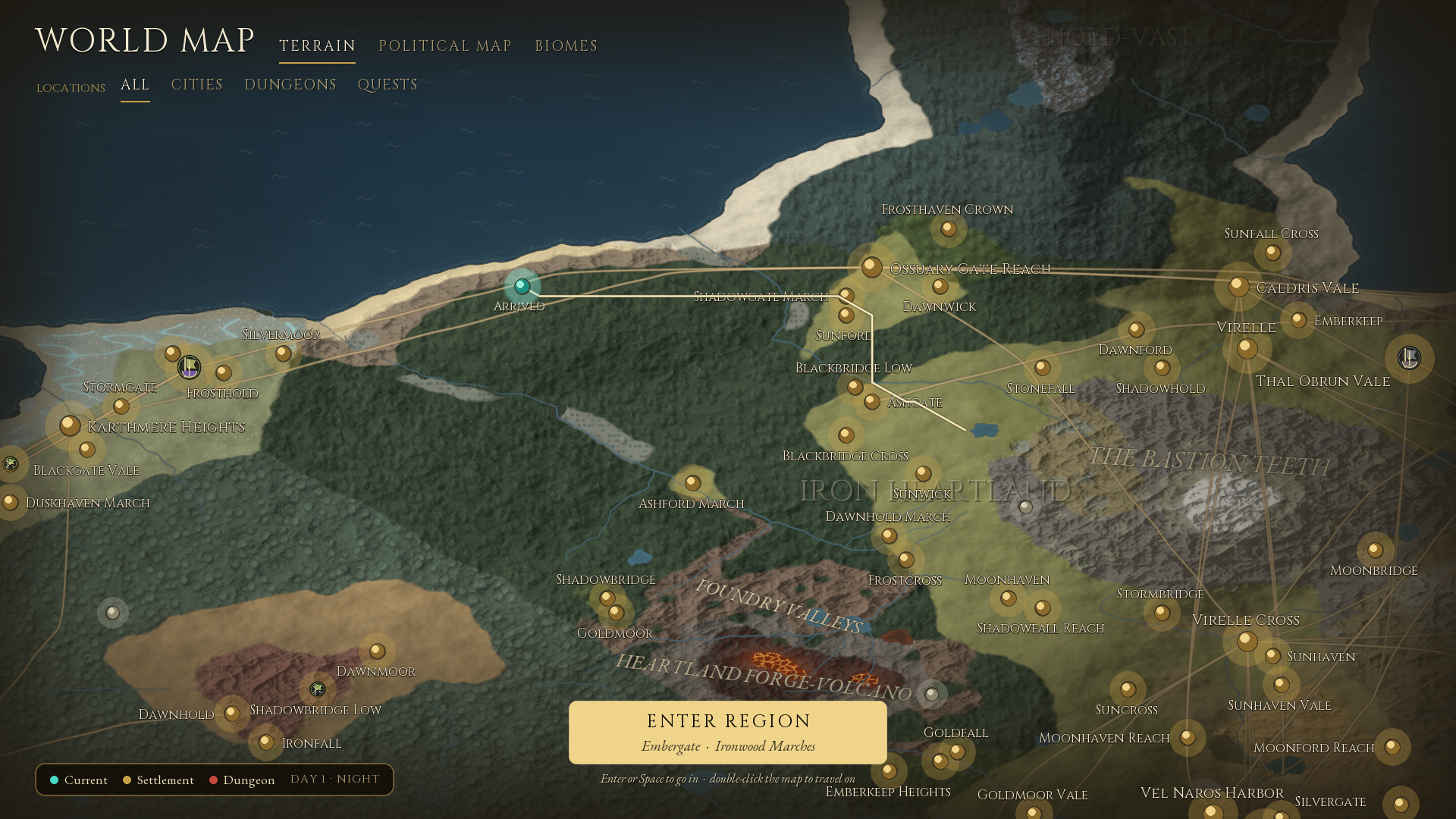
In-game capture · In development
From the map to the road
A journey arrives at its destination. Enter the region and experience the place behind the marker.
The same people. The same history.
The world continues beyond your reign
You can travel, rest, work, explore a dungeon, or pursue a personal relationship while other powers continue their history. Realm decisions and known deeds can become part of the memories that shape later conversations. Strategy is another scale of the same immersive world: the road you walk, the people you speak to, and the power shown on the map share a history. This guide describes development implementations and their intended connections. Validation, broader coverage, balance, and final presentation continue.
Keep reading in the wiki ↗Inside the living simulation →